
POW/MIA FLAG AND LOGO
HISTORY & PROTOCOL
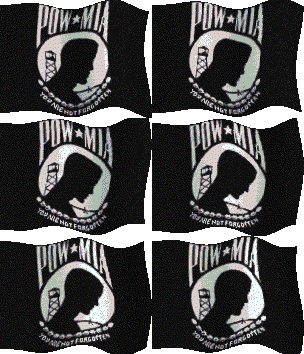
The POW/MIA flag is the only flag other than the American flag ever to fly over the White House. Its display is now required by law at all prominent federal properties on every day the U.S. flag is flown.
HISTORY BEHIND THE FLAG
In 1970, Mrs. Michael Hoff, MIA wife and active member of the National League of POW/MIA Families, recognized the need for a symbol to represent America's POW/MIA. Prompted by an article in the Jacksonville, Florida Times-Union, Mrs. Hoff contacted Norman Rivkees, Vice President of Annin & Company. His company had made a banner for the newest member of the United Nations — the People's Republic of China — as part of their policy to provide flags of all U.N. member states. Mrs. Hoff found Mr. Rivkees very sympathetic to the POW/MIA issue. He and an Annin contractor, the late Newt Heisley, designed a flag to represent our Vietnam War POW/MIA.
Following approval by the League's Board of Directors at a meeting on January 22–23, 1972, POW/MIA flags were manufactured for distribution. Wanting the widest possible dissemination and use of this symbol to advocate for improved treatment for, and answers on, American POW/MIA, no trademark or copyright was sought. As a result, widespread use of the League's POW/MIA flag is not restricted legally.
On March 9, 1989, the official League flag - first flown over the White House on National POW/MIA Recognition Day 1988 - was installed in the U.S. Capitol Rotunda as a result of legislation passed overwhelmingly on a bipartisan basis during the 100th Congress. The League's POW/MIA flag is the only flag ever displayed in the U.S. Capitol Rotunda, where it stands today as a powerful symbol of America's determination to account for U.S. personnel still missing and unaccounted-for from the Vietnam War.
NATIONAL POW/MIA FLAG ACT
On August 10, 1990, the 101st Congress passed U.S. Public Law 101-355, which recognized the League's POW/MIA flag and designated it the official symbol of national concern and commitment to resolving the fates of Americans still prisoner, missing, and unaccounted-for in Southeast Asia.
U.S. Public Law 101-355 · 1990
"The symbol of our Nation's concern and commitment to resolving as fully as possible the fates of Americans still prisoner, missing and unaccounted for in Southeast Asia, thus ending the uncertainty for their families and the Nation."
The 116th Congress further strengthened the law, requiring that the POW/MIA flag be displayed on all days that the flag of the United States is displayed on certain federal properties. Cited as the "National POW/MIA Flag Act," this legislation was signed into law by President Donald Trump on November 7, 2019.
Law now requires the POW/MIA flag to be displayed wherever the American flag flies at prominent federal properties, including: the White House, U.S. Capitol, World War II Memorial, Korean War Veterans Memorial, Vietnam Veterans Memorial, every national cemetery, and the buildings containing the official offices of the Secretaries of State, Defense, and Veterans Affairs.
DISPLAY PROTOCOL
The importance of the POW/MIA flag lies in its continued visibility — a constant signal of the plight of America's unreturned veterans. Proper display honors both those it represents and the law that mandates its presence.
01
When flown with the U.S. flag on a single staff or halyard, the POW/MIA flag should be below the U.S. flag.
02
When flown on adjacent staffs, the U.S. flag should be at the center and highest point when a number of flags are grouped for display.
03
The POW/MIA flag should be the same size as, or smaller than, the U.S. flag - never larger.
04
The POW/MIA flag should be in good condition and replaced when it becomes worn, faded, or tattered - just as with the U.S. flag.
05
At required federal locations, the POW/MIA flag must be flown every day the U.S. flag is displayed, per the National POW/MIA Flag Act of 2019.
LOGO REPRODUCTION
The POW/MIA Logo is and has always been in the public domain for the purpose of helping to spread awareness of our mission. While no copyright was pursued, we do suggest that any person or institution that profits from the logos’ usage directs some of that financial support to POW/MIA awareness organizations and also includes information about missing and unaccounted-for servicemen and their families alongside any orders.